How Do Scientists Determine Which Frequencies Humpback Whales Use to Communicate in Samaná Bay?
Humpback whales are known for producing a wide variety of underwater sounds, including calls, pulses, moans, and the complex sequences commonly called whale songs. During their seasonal breeding migration, these animals visit locations such as Samaná Bay in the Dominican Republic, where researchers and marine observers have opportunities to study their behavior.
One important question is how scientists determine the frequencies of humpback whale vocalizations and what those measurements reveal about whale communication.
Researchers use underwater recording equipment, acoustic analysis software, and specialized measurements to examine the frequency, duration, and structure of whale sounds. These methods help scientists describe vocalizations and investigate how sound patterns vary across different recordings.
Although these techniques can be applied to research in Samaná Bay, specific local frequency ranges or communication patterns should only be reported when supported by recordings and documented studies from the area.
What Is Frequency in Humpback Whale Communication?
Frequency describes how many times a sound wave oscillates per second. It is measured in hertz (Hz).
A sound with a lower frequency generally sounds deeper, while a sound with a higher frequency generally sounds sharper. However, the perceived character of a whale vocalization also depends on its duration, loudness, structure, and the hearing characteristics of the listener.
Humpback whale vocalizations can contain different frequency components. Some sounds have relatively simple tonal structures, while others contain multiple components that change over time.
Scientists study these differences to describe the acoustic characteristics of whale communication.
Importantly, frequency alone does not explain what a whale means when it produces a sound. Understanding the function of a vocalization requires additional evidence about the context in which it occurs.
1. Recording Whale Sounds With Hydrophones
The first step is obtaining underwater acoustic recordings.
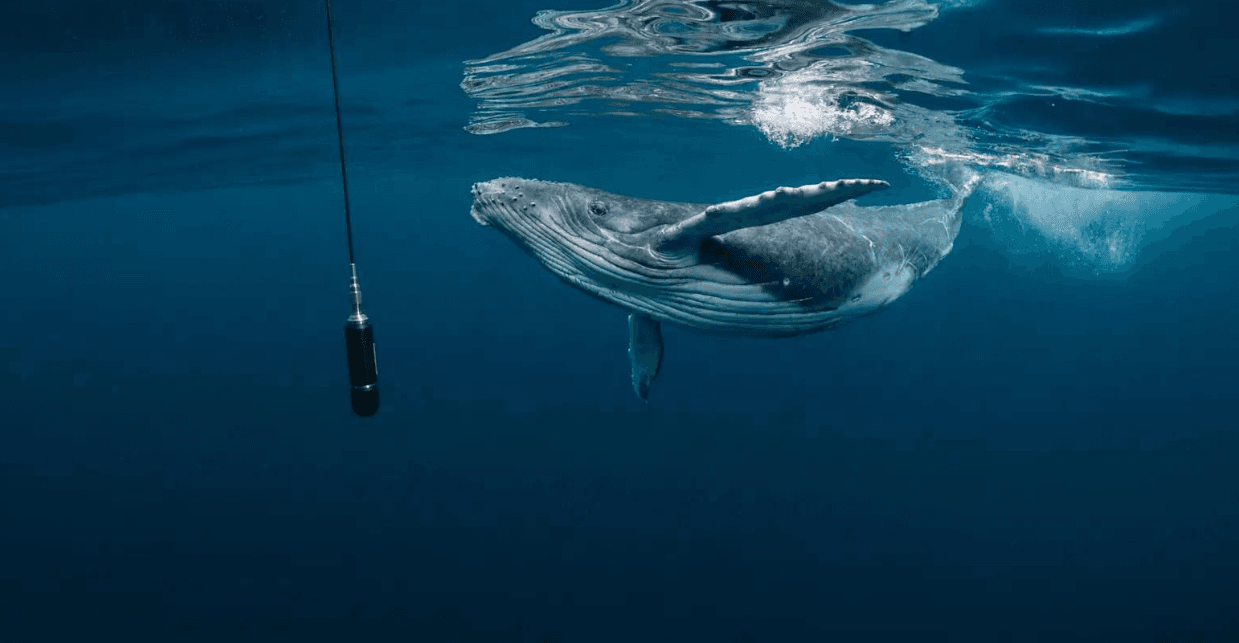
A hydrophone is a specialized sensor that detects sound pressure changes underwater and converts them into signals that can be recorded and analyzed.
Researchers may deploy hydrophones from a research vessel or use suitable fixed monitoring systems. The choice depends on whether they want to study individual encounters, monitor a particular location, or collect recordings over an extended period.
For useful frequency analysis, the recording system must capture the relevant frequency range with adequate sensitivity and sampling quality.
Researchers also document the equipment's position, depth, calibration, and recording settings.
These details matter because equipment limitations can affect which sounds are captured and how accurately their frequencies can be measured.
2. Converting Recordings Into Digital Data
Once the underwater sounds have been recorded, researchers use digital audio files for analysis.
The recording contains a sequence of measurements representing changes in the detected acoustic signal over time.
Scientists can examine these data using software designed for audio analysis and marine bioacoustics.
The system's sampling rate is particularly important. According to the Nyquist sampling principle, a digital recording must have a sampling rate greater than twice the highest frequency being analyzed to represent that frequency without aliasing, subject to the recording system's practical limitations.
For example, a recording system sampling at 48,000 samples per second has a theoretical Nyquist frequency of 24,000 Hz. Its usable frequency range may be lower because of the hydrophone, electronics, and recording filters.
Researchers must select equipment appropriate to the sounds they intend to study.
3. Using Spectrograms to Identify Frequency Patterns
A spectrogram is one of the most useful tools for analyzing whale vocalizations.
It displays time on one axis, frequency on the other, and sound energy through differences in visual intensity.
This representation allows researchers to examine how a vocalization changes throughout its duration.
A spectrogram may reveal:
- Tonal sounds: Narrow frequency bands that may remain relatively stable or change gradually.
- Frequency sweeps: Sounds whose frequencies rise or fall over time.
- Harmonics: Components occurring at multiples of a fundamental frequency.
- Broadband sounds: Acoustic energy distributed across a wider frequency range.
- Repeated patterns: Similar acoustic elements appearing in a sequence.
These characteristics help researchers describe and compare whale vocalizations.
However, a spectrogram does not automatically identify the animal that produced a sound. Scientists must consider the recording context and other possible sound sources before assigning a vocalization to a humpback whale.
4. Measuring the Fundamental Frequency
Some whale vocalizations contain a fundamental frequency, which is the lowest frequency component in a harmonic series.
Higher harmonics may appear at integer multiples of this fundamental frequency.
Researchers can use acoustic software to estimate the fundamental frequency when the recording contains a sufficiently clear and interpretable signal.
This measurement can help describe how a vocalization changes in pitch over time.
However, not every whale sound has an easily identifiable fundamental frequency. Complex calls, overlapping sounds, and noisy recordings may make the estimate uncertain.
Scientists should therefore distinguish between directly measured frequency components and estimated fundamental frequencies.
5. Identifying the Frequency Range of a Vocalization
A single sound may contain energy across multiple frequencies.
Researchers can investigate the frequency range by examining the spectrogram and calculating relevant spectral measurements.
Depending on the study, they might estimate the lower and upper frequencies containing a defined proportion of the sound energy.
They may also examine peak frequency, which identifies a frequency associated with a maximum in the analyzed spectrum.
These measurements answer different questions. Peak frequency does not necessarily represent the full frequency range, and the strongest component does not always reveal the fundamental frequency.
For meaningful comparisons, researchers need consistent measurement methods and clear definitions of the reported values.
6. Comparing Different Types of Humpback Whale Sounds
Humpback whales produce different types of vocalizations, and their acoustic structures can vary.
Scientists may categorize recordings into broad sound types before comparing their frequency characteristics.
For example, researchers could examine whether different call categories show different frequency distributions or whether individual sounds contain similar patterns across recordings.
Whale song is especially interesting because it consists of organized sequences of sounds that can be repeated and modified.
Researchers can analyze individual elements as well as the structure of longer sequences.
Nevertheless, acoustic differences do not necessarily mean that two sounds serve different communication functions. Scientists need additional evidence to understand the role of each vocalization.
7. Investigating Variation Between Individual Whales
Individual humpback whales may produce vocalizations with different acoustic characteristics.
Researchers can investigate this variation when they have reliable recordings linked to identified individuals.
They may compare measurements such as frequency contours, duration, and harmonic structure across recordings.
However, linking a particular sound to a specific whale can be difficult when several animals are vocalizing simultaneously.
Researchers may need synchronized visual observations, specialized recording arrangements, or other supporting evidence to establish which animal produced a particular sound.
They must also account for differences in recording distance, background noise, and equipment characteristics before concluding that an acoustic difference reflects an individual difference.
8. Studying Whale Vocalizations Across the Breeding Season
Long-term recordings can help researchers investigate whether the acoustic characteristics of whale vocalizations change over time.
For example, scientists may compare recordings collected during different parts of the breeding season or across different years.
They could examine whether the frequency distribution of a particular sound category changes, whether certain acoustic patterns appear more often during specific periods, or whether recorded song structures vary.
Such comparisons require consistent recording methods and careful consideration of sampling differences.
A change in the recordings might reflect a genuine change in vocal behavior, but it could also result from different recording locations, background noise, or changes in which whales were detected.
Researchers should not interpret seasonal variation as a confirmed local trend without adequate evidence.
9. Understanding the Effects of Underwater Sound Conditions
The frequency measured by a recording system is not always a complete description of the sound experienced by a whale.
Underwater sound can be affected by distance, water depth, reflections, seabed characteristics, and other properties of the marine environment.
Background noise can also mask parts of a vocalization, making some frequency components more difficult to detect.
Researchers consider these factors when comparing recordings and estimating which parts of a sound are reliably measurable.
It is also important to distinguish frequency from loudness. Two vocalizations can have similar frequency patterns but different sound-pressure levels.
Combining frequency analysis with other acoustic measurements gives scientists a more complete description of whale sounds.
10. Can Frequency Reveal What a Humpback Whale Is Communicating?
Frequency analysis can help scientists identify and describe acoustic patterns, but determining a vocalization's meaning is much more complicated.
Researchers may investigate whether particular sounds occur during specific social interactions or whether different acoustic patterns appear in different behavioral contexts.
They can then examine whether the associations are consistent across multiple observations.
However, a sound's frequency alone cannot establish whether a whale is expressing a particular emotion, communicating a specific message, or responding to another animal.
Understanding communication requires evidence from acoustic recordings, behavioral observations, and the broader circumstances in which vocalizations occur.
Scientific interpretations should reflect the strength and limitations of the available evidence.
Why Frequency Research Matters for Humpback Whale Conservation
Studying whale vocalizations can improve understanding of how humpback whales use sound in their marine environment.
Acoustic monitoring may help researchers document when whales are vocalizing, compare sound patterns over time, and investigate whether human-generated noise overlaps with portions of their vocalizations.
These findings can contribute to broader studies of marine soundscapes and potential acoustic disturbance.
However, frequency overlap alone does not prove that a whale's communication has been disrupted. Researchers must also consider sound levels, exposure duration, distance, signal detectability, and biological evidence.
When combined with responsible monitoring and other ecological research, acoustic studies can contribute to informed conservation planning for humpback whales in Samaná Bay.
Frequently Asked Questions
What frequencies do humpback whales use to communicate?
Humpback whale vocalizations span a range of frequencies, depending on the type of sound. Exact measurements vary among vocalizations and recording conditions, so specific frequency ranges should be supported by appropriate acoustic data.
How do scientists measure whale vocalization frequencies?
Researchers use hydrophones to record underwater sounds and software to analyze the recordings. Spectrograms and spectral measurements help identify frequency components and changes over time.
What does a humpback whale spectrogram show?
A spectrogram displays how acoustic energy is distributed across frequencies over time. It can reveal tonal elements, frequency sweeps, harmonics, and repeated acoustic patterns.
Can scientists identify individual whales by their sounds?
Some acoustic characteristics may help researchers investigate differences between individuals, but reliable identification from sound alone can be challenging. Strong conclusions require appropriate recordings and validation.
Does a higher-frequency whale sound mean the whale is communicating more loudly?
No. Frequency and sound level are different properties. Frequency describes the rate of oscillation, while sound-pressure level describes the magnitude of acoustic pressure relative to a reference.
Why study humpback whale sounds in Samaná Bay?
Acoustic research can improve understanding of whale communication and the underwater sound environment during the breeding season. Local conclusions depend on the availability of reliable recordings and documented research.
Conclusion
Scientists determine the frequencies of humpback whale vocalizations by recording underwater sounds with hydrophones and analyzing them using digital signal processing, spectrograms, and spectral measurements.
These methods help researchers describe sound structure, compare vocalizations, and investigate variation across recordings and behavioral contexts.
Although frequency analysis provides valuable information about humpback whale communication, it cannot independently reveal the complete meaning of a sound. Combining acoustic evidence with behavioral observations and reliable local data offers a stronger foundation for understanding these animals and supporting their conservation in Samaná Bay.

Local explorer & expert guide in Isla Saona Oficial.