How Do Scientists Determine Which Humpback Whale Is Singing?
Humpback whales are known for their elaborate songs, particularly during the breeding season. Scientists can record these sounds underwater and analyze their patterns, but identifying the individual whale responsible for a particular song is a much more difficult task.
A recording may reveal that a humpback whale is singing without showing where the animal is or which individual produced the sound. Even when several whales are visible nearby, researchers cannot automatically assume that the closest whale is the singer.
To investigate individual singing behavior, scientists combine acoustic recordings with methods such as sound-source localization, synchronized visual observations, and photo-identification. Each method provides different evidence, and researchers must evaluate how confidently the observations can be connected.
For people interested in Samaná whale watching in the Dominican Republic, this research explains how scientists can move beyond simply recording whale songs toward investigating which animals may be producing them.
Why Is Identifying a Singing Whale Difficult?
Humpback whale songs travel through water, sometimes reaching recording equipment from animals that cannot be seen at the surface. A singer may remain underwater for an extended period, while other whales surface nearby.
Sound can also travel over substantial distances, depending on its frequency, the surrounding environment, and underwater conditions. Consequently, the animal nearest to a hydrophone is not necessarily the source of the strongest recorded signal.
Researchers face several distinct challenges:
- A vocalization may be recorded without a visual sighting.
- Several whales may occupy the same area.
- Sound reflections may complicate source localization.
- Different whales may produce similar vocalizations.
- An identified whale may be observed near a recording without being proven to be its source.
The central question is not merely whether a whale was present, but whether the available evidence reliably connects that individual to the recorded sound.
1. Recording Whale Songs With Hydrophones
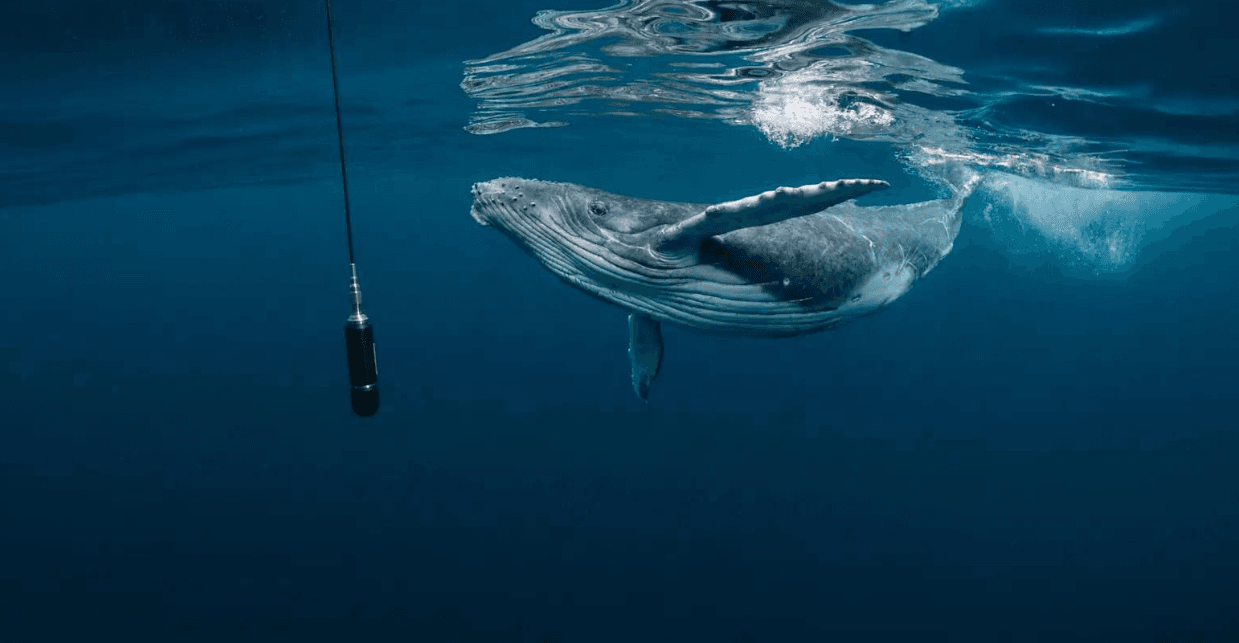
A hydrophone is an underwater microphone designed to detect sound in aquatic environments. Researchers use hydrophones to record whale vocalizations that may not be audible to people aboard a typical whale-watching vessel.
Depending on the study, hydrophones may be deployed from a research vessel, attached to a fixed underwater monitoring system, or arranged in an array of multiple sensors.
Scientists document the equipment, recording location, time, and environmental conditions. These details help them interpret the sound and assess the reliability of later analyses.
A single hydrophone can capture the characteristics and timing of a vocalization, but it generally provides limited information about the direction of the source.
To estimate where a sound originated, researchers may use multiple synchronized hydrophones or other suitable acoustic methods.
Even then, locating a sound source is only one step toward identifying the individual whale.
2. Locating the Source of a Song
Acoustic localization uses recorded sound information to estimate the position or direction of a sound source.
When a vocalization reaches multiple synchronized hydrophones, it may arrive at each sensor at a slightly different time. Scientists can analyze these time differences to estimate where the sound originated.
The accuracy of the estimate depends on several factors, including sensor spacing, synchronization, the speed of sound in water, background noise, and the geometry of the recording system.
Researchers may also use other signal characteristics to improve localization when the equipment and recording conditions permit.
If the estimated source position corresponds to an area where a particular whale was observed, the observations may support a possible connection. However, a location estimate alone does not establish the identity of the singer.
Two whales may be close together, and the source may move while the sound is being recorded. Scientists must therefore consider positional uncertainty and the timing of their observations.
3. Matching Acoustic Recordings With Visual Observations
Visual observations can provide valuable context for an underwater recording.
Researchers may observe whales from a research vessel, record the time of each sighting, photograph distinctive features, and document visible behavior. If these observations are synchronized with acoustic recordings, scientists can examine whether a particular whale's position is consistent with the estimated sound source.
For example, suppose a researcher identifies a whale surfacing in a particular area while a hydrophone array localizes a vocalization nearby. If the timing and position agree, the evidence may support a connection between the whale and the sound.
However, proximity is not proof. Another whale may be submerged in the same area, and the recorded sound may have traveled from farther away.
The strongest conclusions require multiple lines of evidence and a clear explanation of the uncertainty involved.
4. Using Photo-Identification to Recognize Individual Whales
Photo-identification is an established method used in humpback whale research. Scientists photograph distinctive features, particularly the underside of the tail fluke, which often displays patterns of pigmentation, scars, and other markings.
Researchers compare these photographs with catalogued images to determine whether a whale has been documented previously.
Over time, photo-identification can help scientists investigate where an individual whale has been observed and whether it returns to particular regions.
But photo-identification does not directly identify a singer. A photograph can establish the identity of a visible whale, while acoustic evidence is needed to investigate whether that animal produced a particular sound.
To link the two forms of evidence, researchers need appropriately timed observations and a reliable way to connect the vocalization to the whale.
This distinction prevents a common interpretive mistake: assuming that the identified whale in a photograph must be responsible for every sound recorded nearby.
5. Can Scientists Identify a Whale From Its Voice Alone?
Researchers can compare vocal characteristics across recordings, but identifying an individual whale from its voice alone is challenging.
A whale may produce different sounds depending on the type of vocalization and the circumstances in which it occurs. Acoustic patterns may also overlap among individuals.
Some vocal features may help distinguish recordings, but a consistent difference between two recordings does not necessarily prove that two different whales produced them. Likewise, similar recordings do not establish that the same individual produced both.
To evaluate individual identity from acoustic evidence, researchers need validated methods and sufficient reference recordings from known sources.
A useful dataset would include recordings reliably linked to identified animals, allowing researchers to test whether particular features remain consistent within individuals and differ meaningfully between them.
Without such validation, scientists should describe recordings as acoustically similar or different rather than claiming certain individual identification.
6. Tracking a Singer Across a Recording Session
Once a sound source has been localized, researchers may attempt to track its movement during a recording session.
An array of hydrophones can provide successive source-location estimates when conditions are suitable. Scientists can compare these estimates over time to investigate whether the source appears to move through the study area.
Visual observations may help refine this interpretation if a whale can be followed independently.
Tracking can become difficult when multiple whales overlap acoustically, when a source is temporarily undetectable, or when location estimates have large uncertainties.
Researchers must also distinguish a continuous track from a series of separate detections. Two sounds recorded at different times do not necessarily come from the same animal simply because their estimated positions are close.
Careful analysis of timing, acoustic characteristics, and movement helps reduce these ambiguities.
7. Separating Songs From Multiple Whales
When multiple whales vocalize at once, scientists may need to separate overlapping signals before attempting individual identification.
They can examine spectrograms, compare frequency contours, and analyze the timing of individual acoustic events. Synchronized hydrophone arrays may provide additional information about the direction of different sources.
Signal-processing and computational methods can sometimes help isolate overlapping components, although their performance depends on recording quality and the similarity of the signals.
The resulting components must be checked against the original recording. Processing can introduce artifacts or remove details that matter for interpreting a vocalization.
Even when scientists successfully separate two acoustic sources, they may not know which individual whales produced them. Source separation and individual identification are different stages of the analysis.
8. How Researchers Evaluate the Strength of the Evidence
Scientists should not treat every connection between a sound and a visible whale as equally reliable.
A useful approach is to evaluate the available evidence in stages.
Acoustic detection: A sound is clearly recorded and its characteristics can be analyzed.
Source localization: The recording provides a credible estimate of the direction or location of the vocalization.
Visual association: An identified whale is observed at a compatible location and time.
Independent confirmation: Additional evidence supports the proposed link between the sound and the individual animal.
Not every study can complete every stage. Some recordings may support only acoustic analysis, while others may allow stronger conclusions through synchronized observations.
Researchers should report what their methods establish and avoid presenting a possible association as a confirmed identification.
9. Why Identifying Individual Singers Matters
Linking songs to individual whales can help researchers investigate questions that cannot be answered by acoustic pattern analysis alone.
For example, they may ask whether particular individuals sing repeatedly during a study period, whether singing is associated with certain observed behaviors, or whether identified whales produce similar vocal patterns at different times.
When sufficiently reliable data are available, researchers can also investigate how vocal behavior varies among individuals.
However, these questions require careful study design. A whale that is recorded singing frequently may simply have been observed for longer than other whales. Similarly, the absence of a recording does not prove that a whale was silent.
Researchers must account for detection probability, recording effort, and uncertainty when interpreting individual singing behavior.
10. What This Research Could Reveal in Samaná Bay
Samaná Bay in the Dominican Republic is a recognized seasonal destination for humpback whale watching. Surface observations can document visible whales and their behavior, while underwater acoustic recordings can provide information about vocal activity.
Researchers could combine these approaches to investigate which identified whales may be producing recorded sounds, provided suitable local data and methods are available.
Such a study might involve synchronized acoustic recordings, careful location estimates, photo-identification, and documented observation times. Researchers would also need to consider overlapping whales, vessel noise, and the movement of animals beneath the surface.
It would be inappropriate to claim that a specific singer has been identified in Samaná Bay without supporting evidence from an actual study.
For visitors, the broader lesson is that the whales visible from a boat represent only part of the underwater scene. Acoustic research can help scientists investigate the animals producing sounds even when they cannot be observed directly.
Common Challenges in Identifying Individual Singing Whales
Several factors can limit the reliability of individual identification.
Overlapping animals: More than one whale may be present near the estimated source.
Long-distance sound transmission: A recorded vocalization may originate farther from the hydrophone than expected.
Similar vocal characteristics: Different individuals can produce comparable acoustic patterns.
Uncertain timing: Visual observations and audio recordings may not be synchronized precisely enough.
Limited photographic evidence: A whale may be recorded without being photographed or positively identified.
Changing source positions: Whales may move during a recording session, complicating localization.
Incomplete reference data: Researchers may lack enough recordings from known individuals to validate acoustic identification.
Recognizing these limitations is essential for distinguishing a plausible association from a scientifically supported identification.
Frequently Asked Questions
Can scientists identify an individual humpback whale by its song?
Potentially, under suitable conditions and with validated evidence. Acoustic similarity alone is not enough to establish individual identity reliably.
How do researchers know which whale is singing underwater?
They may combine hydrophone recordings, acoustic localization, synchronized visual observations, and other evidence. The strength of the conclusion depends on how clearly these sources of information agree.
Does a whale's tail-fluke photograph identify its song?
No. Photo-identification can establish which whale was observed, but separate evidence is needed to link that animal to a particular vocalization.
Can hydrophones track a singing whale?
Multiple synchronized hydrophones can sometimes estimate a sound source's location over time. The accuracy depends on the equipment, environmental conditions, and the quality of the recorded signals.
Why is individual singer identification useful?
It can help researchers study individual variation, repeated singing behavior, and possible relationships between vocal activity and observed behavior.
Can this research identify singing whales in Samaná Bay?
It may be possible with suitable local acoustic recordings and supporting observations. Any claim about a particular whale must be supported by reliable evidence rather than inferred from a nearby sighting alone.
Conclusion
Determining which humpback whale is singing requires scientists to connect acoustic evidence with information about the animals present. Hydrophones can record vocalizations, synchronized arrays can help estimate sound-source locations, and photo-identification can establish the identity of visually observed whales.
The challenge is linking these separate observations reliably. A whale seen near a recording is not automatically the singer, and a sound's acoustic characteristics do not necessarily reveal an individual's identity.
For those interested in Samaná whale watching, understanding these methods offers a deeper appreciation of the science behind whale research. By carefully combining acoustic and visual evidence, scientists can investigate individual singing behavior while remaining transparent about what their data can and cannot establish.

Local explorer & expert guide in Isla Saona Oficial.