How Do Humpback Whales Sleep A Samaná Whale Guide
Humpback whales spend much of their lives traveling through the ocean, feeding in productive waters, communicating with other whales, and migrating between seasonal habitats. But just like humans and other mammals, they also need time to rest.
Their sleeping habits are especially fascinating because whales cannot simply settle down on land and sleep for hours without interruption. They live underwater, breathe air, and must return to the surface to take their next breath.
So, how do humpback whales sleep without drowning Do they sleep at the surface, rest underwater, or remain in motion while recovering?
Understanding how humpback whales rest reveals another remarkable aspect of their biology. For visitors exploring Samaná Bay in the Dominican Republic, it also provides a reason to appreciate the quieter moments of whale watching, when an animal may be resting rather than performing a spectacular jump.
Can Humpback Whales Sleep Underwater?
Yes. Humpback whales can rest and sleep in the water. However, their sleeping behavior must accommodate an essential biological requirement: they breathe air through their blowholes.
Unlike humans, whales do not breathe automatically in exactly the same way throughout every stage of sleep. Cetaceans have specialized adaptations that allow them to rest while maintaining the ability to breathe.
Research on cetaceans has documented a form of sleep known as unihemispheric slow-wave sleep. During this type of sleep, one brain hemisphere shows sleep-related activity while the other remains relatively more alert.
This arrangement is well documented in several cetacean species. The exact details of sleep patterns can differ between species, and researchers have less direct information about some aspects of sleep in free-ranging humpback whales than they do for certain dolphins and other well-studied cetaceans.
The important point is that whales have evolved ways to balance rest with the demands of living in an aquatic environment.
Why Must Whales Surface While Sleeping?
Humpback whales are mammals with lungs, not gills. They obtain oxygen from the air and cannot extract it directly from seawater.
When a whale surfaces, it exhales through its blowholes and then inhales before diving again. Its breathing cycle is adapted to periods of swimming underwater followed by brief visits to the surface.
This creates a special challenge during sleep. The whale must remain capable of surfacing when it needs air.
Whales therefore cannot rely on uninterrupted sleep in the same way a person might sleep in a bedroom. Their resting behavior must accommodate breathing, movement, and awareness of their surroundings.
The respiratory system, diving ability, and sleep-related brain activity work together to help cetaceans meet these needs.
Do Humpback Whales Sleep With One Eye Open?
The idea of sleeping with one eye open is often associated with dolphins and other cetaceans.
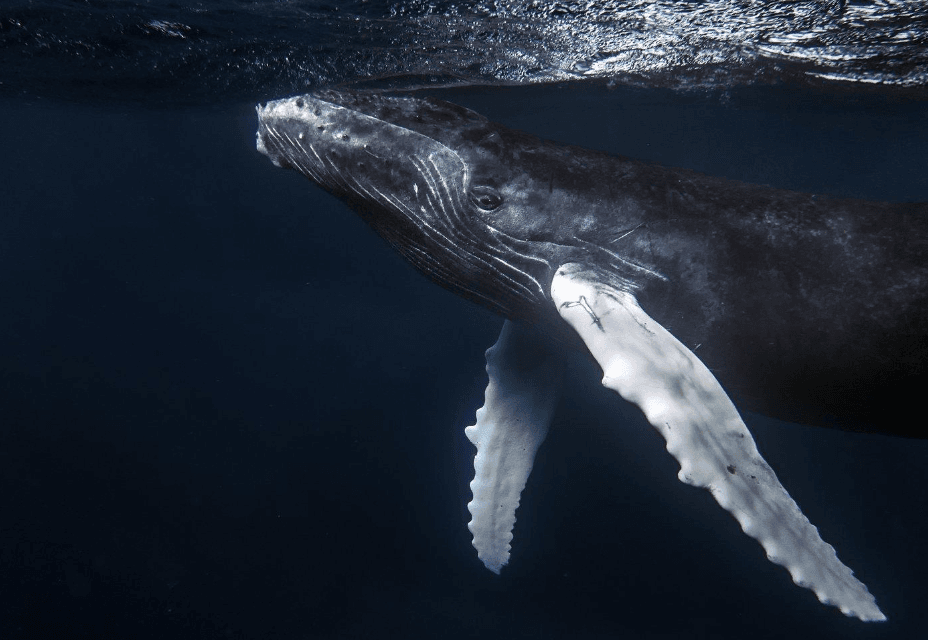
In species that demonstrate unihemispheric sleep, one eye may remain open while the opposite brain hemisphere is more active. This arrangement may help an animal monitor its surroundings while part of its brain rests.
However, the precise relationship between eye position and sleep should not be generalized to every whale species or every resting situation.
For humpback whales, it is safest to say that cetaceans have specialized sleep adaptations, while acknowledging that detailed observations of eye position during different sleep states are more limited for some large whale species.
A whale seen with its eye visible at the surface cannot automatically be classified as asleep or awake. Determining an animal's sleep state requires more than a brief visual observation.
Where Do Humpback Whales Rest?
Humpback whales may rest in the water column or near the surface, depending on their circumstances and behavior. Their resting locations can be influenced by environmental conditions, their activity, and their stage of life.
A whale near the surface may appear unusually still compared with an individual that is traveling, feeding, or socializing.
Observers sometimes use the term logging to describe a whale or other cetacean lying relatively motionless at the surface, resembling a floating log. Such behavior can be associated with rest, but a brief sighting does not prove that the animal is sleeping.
Whales can also rest underwater, where their movements may be difficult for people on boats to observe.
In Samaná Bay, whale-watching visitors should remember that a quiet whale is not necessarily an unhealthy whale. Resting and other low-activity behaviors are natural parts of animal life.
How Long Do Humpback Whales Sleep?
There is no single, well-established number of hours that can confidently describe the sleep schedule of every humpback whale.
Sleep duration and organization can vary with species, age, activity, environmental conditions, and other factors. Studying sleep in a large, free-swimming whale is also difficult because researchers cannot observe every aspect of its brain activity and behavior continuously under natural conditions.
Scientists use different research methods to investigate cetacean behavior, including direct observation, acoustic monitoring, tagging where appropriate, and studies of animals under controlled conditions when ethical and practical.
Findings from one cetacean species should not automatically be treated as a precise measurement of sleep in humpback whales.
For visitors, this uncertainty is part of the scientific story: many aspects of whale biology are understood, but questions remain about exactly how these enormous animals organize their daily rest.
Do Humpback Whale Calves Sleep Differently From Adults?
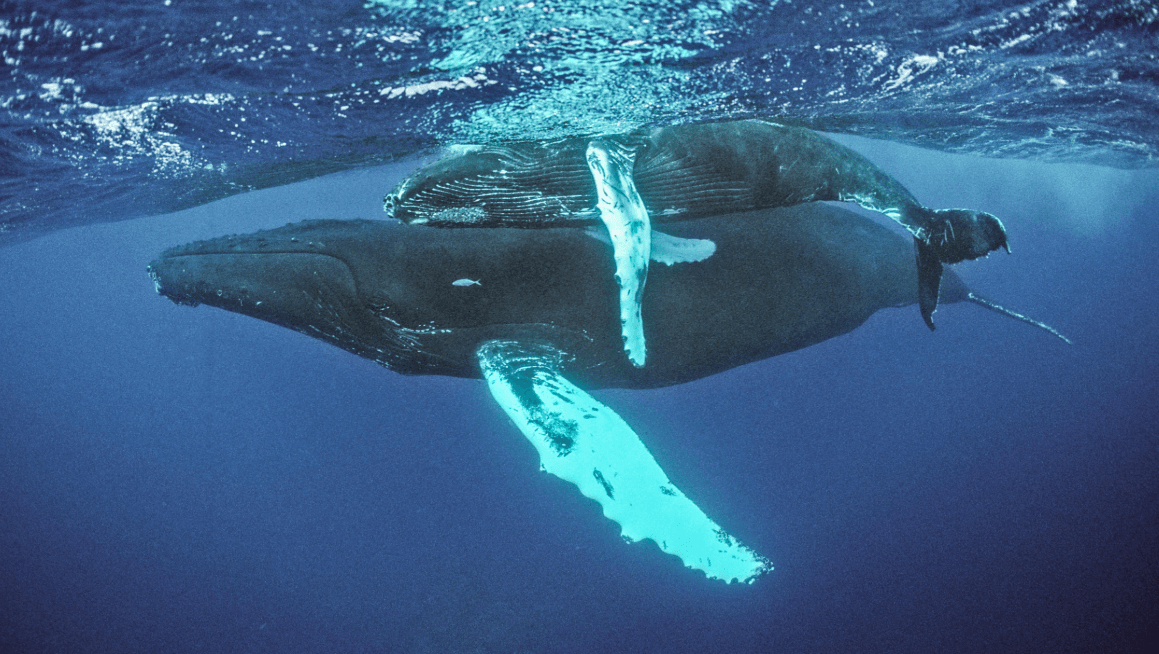
Young humpback whales depend heavily on their mothers during their early lives. A calf stays close to its mother while nursing, swimming, and learning to navigate its environment.
The mother and calf must coordinate their movements and remain in a suitable relationship as they travel through the water. Rest must fit into this demanding early stage of development.
Scientists have investigated maternal care and resting behavior in cetaceans, but it is important not to assign an exact sleep schedule to humpback calves without reliable species-specific evidence.
A calf resting near its mother is not necessarily asleep, just as a calf swimming slowly is not necessarily awake in the same sense as a highly active animal.
When observing a mother and calf during whale watching, visitors should focus on their natural behavior and allow the pair plenty of space. A close approach can interfere with their movement and may cause unnecessary disturbance.
What Can Disturb a Resting Whale?
Whales live in an environment filled with natural sounds, other animals, and changing ocean conditions. Human activities can add further disturbances.
Potential sources of disturbance include vessel traffic, underwater noise, and boats approaching too closely. The effects depend on the situation, the animal, and the type and intensity of the disturbance.
A whale may change its direction, speed, diving pattern, or other behavior in response to a disturbance. However, observers should not assume that every change in behavior is caused by a nearby boat.
Responsible whale watching helps reduce avoidable pressure on these animals. Operators should follow local regulations, maintain appropriate distances, avoid chasing whales, and give animals the freedom to move away.
Respecting a whale's space is especially important when observing mothers with calves or animals that appear to be resting.
Can You See a Sleeping Humpback Whale in Samaná Bay?
It is possible to observe a humpback whale displaying quiet or low-activity behavior during a whale-watching trip. However, it can be difficult to determine whether the animal is actually sleeping from a boat.
During the seasonal breeding migration, humpback whales visit the waters around Samaná, where visitors may see surfacing, diving, tail movements, social interactions, and other behaviors.
Not every encounter includes dramatic activity. A whale may spend much of a sighting moving slowly or remaining relatively still between breaths.
These quieter encounters can still be rewarding. They give visitors a chance to appreciate the animal's size, breathing rhythm, movements, and relationship with the surrounding ocean.
The best approach is to follow the guide's instructions, observe patiently, and avoid pressuring the captain to move closer to a whale simply to obtain a better view.
How to Observe Whale Behavior Responsibly
If you are planning a whale-watching trip in Samaná Bay, a few simple habits can make the experience better for both visitors and wildlife.
Choose a responsible operator. Look for a company that follows local wildlife-viewing regulations and prioritizes animal welfare.
Observe before photographing. Take time to watch how the whale surfaces, moves, and dives instead of focusing exclusively on your camera.
Avoid demanding close approaches. A good wildlife encounter does not require touching, chasing, or surrounding an animal.
Listen to your guide. Experienced guides can help interpret visible behavior while explaining what cannot be determined from a brief sighting.
Be patient with quiet encounters. Resting, traveling, and surfacing are all natural parts of a whale's life, even when they are less dramatic than a breach.
Responsible observation allows visitors to enjoy the experience while respecting the animals' need for space.
Frequently Asked Questions
Do humpback whales sleep underwater?
Yes. Humpback whales can rest and sleep in the water. Their sleeping behavior must accommodate their need to surface for air.
Can humpback whales drown while sleeping?
Whales have specialized adaptations that help them rest while maintaining the ability to breathe. They are not immune to respiratory problems or other dangers, but their normal resting behavior is adapted to aquatic life.
Do humpback whales sleep at night?
Humpback whales need rest, but their sleep patterns should not be assumed to follow a strict human-like nighttime schedule. Their activity and rest may vary with circumstances.
Do whales stop swimming when they sleep?
Resting behavior varies. Some cetaceans can remain relatively still, while other forms of rest may involve movement. A whale's exact sleep state cannot reliably be identified from movement alone.
Can whale-watching boats see sleeping whales?
Visitors may see whales resting or behaving quietly, but it is usually difficult to confirm that a whale is asleep from a surface observation alone.
When is the whale-watching season in Samaná?
Humpback whales generally visit the Samaná region during the winter breeding season, commonly from January through March. Sightings vary, so check current local information when planning a trip.
Final Thoughts
Humpback whale sleep is a fascinating example of how marine mammals adapt to life in the ocean. They need rest, but they must also breathe air, remain capable of surfacing, and respond to their surroundings.
Although researchers continue to investigate the details of sleep in large whales, existing cetacean research shows that resting in water requires specialized biological adaptations.
During whale watching in Samaná Bay, remember that every encounter does not need to include a dramatic leap. Sometimes the most interesting observation is a whale moving quietly through the water or surfacing for a breath.
By learning about these less visible aspects of whale life and choosing responsible wildlife tours, visitors can develop a deeper appreciation for humpback whales and the marine environment they inhabit.

Local explorer & expert guide in Isla Saona Oficial.