How Do Scientists Measure the Swimming Speed of Humpback Whale Calves in Samaná Bay?
Samaná Bay in the Dominican Republic is a well-known seasonal destination for humpback whales. During the breeding season, observers may see adults and calves swimming, surfacing, and moving through the bay's waters.
One question researchers can investigate is how quickly young humpback whales swim under different conditions. Measuring swimming speed can help scientists understand movement patterns, coordination with adults, and how young whales use their habitat.
However, calculating a calf's speed is more complicated than simply watching it move across the water. Researchers must estimate distance, measure elapsed time, and account for waves, currents, viewing angles, and changes in direction.
Why Do Scientists Study Calf Swimming Speed?
Swimming speed is one measure of how an animal moves through its environment. For humpback whale calves, movement observations can help researchers explore early development and interactions with their surroundings.
Scientists may investigate questions such as:
- How does a calf's swimming speed vary during an observation?
- Does its movement change when the accompanying adult changes direction?
- How does swimming speed differ between straight-line travel and turning?
- How do sea conditions affect estimates of movement?
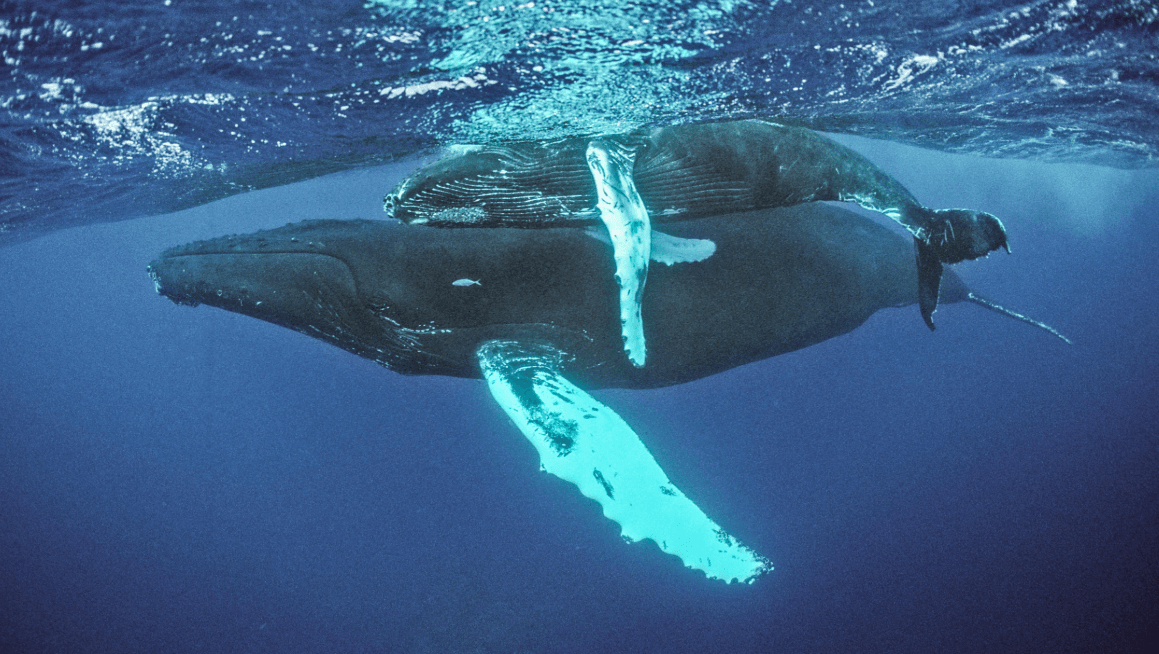
- How consistently does a calf maintain its position relative to an adult?
These questions require reliable measurements and repeated observations. A brief encounter cannot establish a calf's typical swimming speed or prove that its swimming ability changes with age.
1. Measuring the Distance Traveled
The first step is determining how far the calf moves during a known period.
Researchers may record the whale's position at two or more times using suitable observation equipment. Depending on the study, this could involve GPS-referenced observations, synchronized video, photogrammetry, or other tracking techniques.
For example, researchers might estimate a calf's position at the beginning and end of a short observation interval. Comparing these positions provides an estimate of its displacement—the straight-line distance between the starting and ending points.
Displacement is not always the same as the total distance traveled. If a whale turns or follows a curved path, the actual distance it swims may be longer than the straight-line distance between its positions.
Accurate measurements therefore depend on what the study intends to calculate.
2. Recording the Time Interval
Once researchers have suitable position measurements, they need to know how much time elapsed between them.
A synchronized clock, video timestamp, or recorded observation time can establish the interval. Short intervals may help capture rapid changes in movement, while longer intervals can provide information about movement over a broader period.
The appropriate interval depends on the research question and the accuracy of the available equipment.
If timing is inaccurate, the calculated speed will also be inaccurate. Researchers must therefore record times consistently and ensure that the position measurements correspond to the correct moments.
3. Calculating Swimming Speed
Average speed is calculated by dividing the distance traveled by the time taken.
The basic formula is:
Average speed = Distance traveled ÷ Time elapsed
For example, suppose a hypothetical observation estimates that a calf travels 30 meters in 15 seconds.
The calculation is:
30 meters ÷ 15 seconds = 2 meters per second.
This is an illustrative calculation, not a measured swimming speed for a humpback whale calf in Samaná Bay.
Scientists should specify whether their distance represents the whale's estimated path length or its straight-line displacement. The distinction matters when interpreting the result.
4. Using Video to Study Movement
Video can help researchers examine how a whale moves between observation points.
When the camera position and viewing geometry are known or can be estimated, researchers may analyze recorded footage to measure changes in position over time. Repeated video frames can provide movement estimates, and multiple observation points can reveal changes in direction.
However, ordinary video does not automatically provide accurate real-world distances. The whale may move toward or away from the camera, changing its apparent size and position on the image.
Researchers must account for camera movement, viewing angle, distance, and other sources of error before converting image measurements into swimming speed.
5. Distinguishing Swimming Speed From Boat Movement
A research vessel may drift, turn, or travel while a whale is being observed. If scientists measure the whale's position only relative to the boat, the boat's own movement can distort the estimated speed.
Researchers can address this by recording the vessel's position and movement, using appropriate reference points, and applying methods that distinguish the whale's movement from the observer's movement.
For instance, a whale that appears stationary relative to a moving boat may actually be traveling through the water. Conversely, a whale may appear to move rapidly across the camera's view because the boat is turning.
Accounting for the observation platform is essential for meaningful speed estimates.
6. Accounting for Ocean Currents
Swimming through the water and moving across the ocean floor are not exactly the same thing.
A current can carry a whale forward or push it sideways while it swims. Consequently, its speed relative to the surrounding water may differ from its speed relative to the seabed.
Scientists need to be clear about which type of speed they are measuring. Depending on the study, they may combine whale position records with current measurements or other environmental data.
This distinction is particularly important when comparing observations made under different ocean conditions.
7. Comparing Movement During Different Behaviors
A calf's speed may vary according to what it is doing. Researchers can record whether a calf appears to be traveling steadily, turning, surfacing, or moving in association with an adult.
These categories can help scientists compare movement under different observed conditions, provided the behavior is classified consistently.
However, a brief change in speed does not necessarily indicate fatigue, distress, or a developmental difference. Researchers need additional evidence before interpreting the reason for a movement change.
They should also avoid assuming that every calf follows the same behavioral pattern.
8. Understanding Measurement Uncertainty
Every swimming-speed estimate contains some uncertainty.
Possible sources include:
- Inaccurate distance estimates.
- Timing errors.
- Limited visibility below the surface.
- Camera movement and changing viewing angles.
- Ocean currents and vessel movement.
- Missing observations between recorded positions.
Researchers can reduce uncertainty by using calibrated equipment, synchronized timestamps, repeated measurements, and transparent data-analysis methods.
They may also report ranges or uncertainty estimates rather than presenting every calculated speed as an exact value.
Reliable results depend not only on the final number but also on how the measurement was obtained.
9. What Swimming-Speed Research Can Reveal About Calf Development
Repeated movement measurements may help scientists investigate how calves move through their habitat and coordinate with accompanying adults.
If researchers have sufficient observations from identifiable calves over time, they may be able to explore whether movement characteristics vary with developmental stage or particular behaviors.
Such conclusions require suitable comparisons and controls for factors such as individual differences, currents, observation conditions, and the whale's activity.
A single sighting cannot establish a calf's normal swimming speed, and observations from one location should not automatically be treated as representative of every humpback whale calf.
No specific local swimming-speed pattern should be attributed to Samaná Bay without supporting research data.
Frequently Asked Questions
How do scientists calculate humpback whale calf swimming speed?
They estimate the distance traveled, record the elapsed time, and divide distance by time. The accuracy depends on how well both measurements are established.
Can scientists measure swimming speed from a boat?
Yes, suitable observations can be made from a boat, but researchers must account for vessel movement, viewing geometry, distance, and other sources of error.
Do ocean currents affect swimming-speed measurements?
Yes. Currents can influence a whale's movement relative to the seabed, so researchers must distinguish movement through the water from movement over the ground when relevant.
Is a calf's swimming speed always constant?
No. Speed can vary with behavior, direction changes, environmental conditions, and individual differences.
Does swimming speed reveal a calf's exact age?
No. Speed alone cannot establish a calf's age. Age estimation requires different evidence and methods.
Conclusion
Measuring humpback whale calf swimming speed in Samaná Bay requires careful observation, reliable distance and timing measurements, and an understanding of the surrounding ocean conditions.
Scientists can estimate speed using tracked positions, timed observations, and suitable video or research equipment. They must also distinguish the whale's movement from boat movement and account for currents, turning, and measurement uncertainty.
With well-documented observations, swimming-speed research can contribute to a better understanding of calf movement and behavior. The most useful conclusions are those supported by repeated measurements and presented with appropriate scientific caution.

Local explorer & expert guide in Isla Saona Oficial.