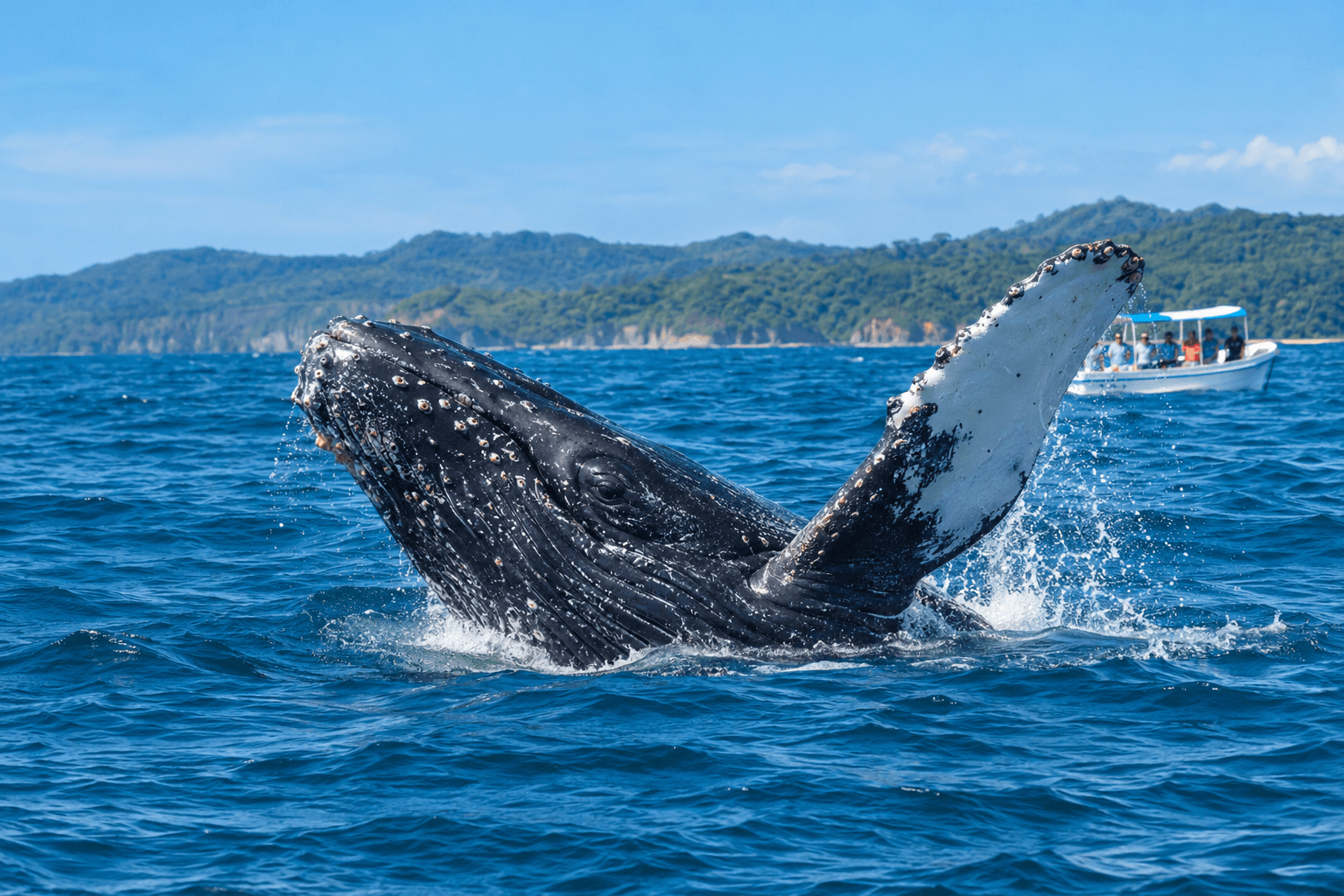
Why Do Humpback Whales Sometimes Swim on Their Sides?
Humpback whales are known for their powerful swimming, long pectoral fins, and impressive movements at the ocean's surface. But sometimes, a whale appears to tilt sideways, roll onto one side, or travel through the water at an unusual angle.
For people observing humpback whales in Samaná Bay, Dominican Republic, this movement can raise an interesting question: why would such a large animal swim on its side instead of keeping its body level?
The answer depends on the situation. A sideways position may be part of a roll, a turn, a surface movement, or another activity. The appearance alone does not reveal the whale's exact purpose.
In this guide, we explore what lateral swimming looks like, how humpback whales control their body position, and what visitors can reasonably learn from observing this behavior.
What Does It Mean When a Humpback Whale Swims on Its Side?
When a humpback whale swims on its side, its body rotates so that one side faces more toward the surface than usual. The movement may be brief, or the whale may maintain a tilted position while performing another action.
This behavior can look different depending on the whale's orientation. Sometimes, one pectoral fin becomes more visible. In other cases, the whale's side or belly may appear above the water as it rolls.
It is important to distinguish between a sustained sideways swimming position and a short roll. A whale can rotate temporarily while turning or changing its orientation without traveling sideways for an extended period.
Humpback whales have flexible bodies and large pectoral fins that help them maneuver through the water. Their movements are not restricted to a single upright position.
For observers, the most useful first step is to describe what is visible: the whale tilted, rolled, turned, or exposed one side of its body. Determining why it did so requires more context.
How Do Humpback Whales Control Their Body Position?
Humpback whales control their movement through coordinated actions involving their body, tail flukes, and pectoral fins.
The tail flukes generate much of the thrust needed for swimming. The pectoral fins contribute to maneuvering and control, helping the whale change direction and adjust its orientation.
When a whale rolls or tilts, it changes how its body is positioned relative to the water. This can alter the orientation of its fins and the way it moves through the surrounding water.
A whale may rotate while turning, changing depth, or performing a surface movement. The exact motion depends on the animal's speed, body angle, and the action it is carrying out.
Although a whale's size can make its movements look slow from a boat, humpback whales are capable of substantial changes in orientation.
This ability is useful in an environment where animals must maneuver in three dimensions. The ocean allows movement forward, backward relative to the observer's viewpoint, upward, downward, and through a range of rolling and turning motions.
Is Sideways Swimming a Way for Humpback Whales to Turn?
A sideways tilt can accompany a turn, but not every sideways movement is necessarily a turning maneuver.
When a whale changes direction, it may rotate its body and adjust its pectoral fins. This can make one side of the animal more visible above the surface.
The whale's movement may look particularly unusual when it turns near the waterline, where observers can see the relationship between its body, fins, and the surface.
However, a single photograph or brief sighting may not show the complete turn. The whale could be changing depth, rolling, or continuing another movement that began underwater.
To interpret the behavior more carefully, watch the sequence before and after the tilt. Does the whale change its direction of travel Does it continue rolling Does it surface again in a different orientation?
These observations can help describe what happened without claiming to know the whale's precise intention.
Why Might a Humpback Whale Roll Near the Surface?
Humpback whales sometimes roll or rotate near the surface, exposing different parts of their bodies.
Surface rolling can occur in a variety of contexts, including social activity and other movements. Its function is not always clear from a brief observation.
For example, a whale might roll while moving close to another whale, but that does not prove the roll was a deliberate signal. The movement could be associated with a wider interaction, or its purpose might remain unknown.
A whale rolling alone may also be performing a movement whose function cannot be established from the surface view.
Researchers consider the surrounding circumstances when studying these behaviors. They may record how often the movement occurs, whether other whales are nearby, and what actions precede or follow it.
For whale watchers, the lesson is simple: rolling is a visible behavior worth noticing, but it should not automatically be assigned one universal meaning.
Can Sideways Swimming Help Humpback Whales Use Their Pectoral Fins?
Humpback whales have exceptionally long pectoral fins relative to many other whale species. These fins play an important role in maneuvering and controlling movement.
When a whale tilts onto one side, the orientation of its pectoral fins changes relative to the water. This may be part of a turn, roll, or other movement that involves adjusting the body's position.
A fin that appears to rise above the surface may simply be exposed because the whale has rotated. Its appearance does not necessarily mean the animal is intentionally waving or displaying the fin.
The whale's long fins also make some movements particularly noticeable to observers. A relatively small change in body orientation can reveal a large area of one fin.
If you see a humpback whale rolling in Samaná, observe how its fins move relative to the body. This can help you understand the physical movement, even if the behavior's exact purpose remains uncertain.
Does Swimming on One Side Mean a Whale Is Injured?
Not necessarily. A brief sideways position or roll is not enough to conclude that a humpback whale is injured.
Healthy whales can perform a range of movements, including turns, rolls, and changes in orientation. These actions may look unusual when viewed from a boat, particularly if the observer sees only part of the sequence.
At the same time, a photograph or short sighting cannot establish an animal's overall condition. If a whale shows persistent abnormal movement or other concerning signs, trained personnel and researchers would need more information to assess the situation.
Visitors should not attempt to approach a whale more closely to investigate a suspected injury. Doing so could endanger passengers and disturb the animal.
If you are concerned about a whale's appearance, follow the tour crew's guidance and let the appropriate local authorities or qualified wildlife professionals handle any necessary assessment.
A careful observer avoids both extremes: assuming that every unusual movement is a problem, and assuming that every movement proves the animal is healthy.
Do Humpback Whales Swim Sideways During Social Interactions?
Humpback whales may display a variety of body positions during encounters with other whales. These can include rolling, changes in orientation, and movements that bring different parts of the body close to the surface.
In some situations, body positioning may form part of a social interaction. However, the significance of an individual roll or tilt is not always obvious.
The wider context matters. Researchers may examine whether several whales are close together, whether movements are repeated, and whether the animals change their positions in relation to one another.
Even with this information, it may be difficult to assign a precise meaning to a single action.
A whale turning onto its side near another whale should not automatically be described as greeting, playing, challenging, or communicating with that animal. Such explanations require supporting evidence.
During a whale-watching trip, it is better to describe the visible interaction accurately and let your guide explain what is known about the behavior.
Is Sideways Swimming the Same as Breaching?
No. Sideways swimming, rolling, and breaching are different types of movement.
Sideways swimming describes a whale moving while its body is tilted relative to its usual orientation.
Rolling involves rotation around the body's lengthwise axis, potentially exposing the side or belly.
Breaching occurs when a whale launches part or much of its body out of the water before falling back onto the surface.
These behaviors can sometimes occur within the same sequence, but they are not interchangeable terms. A whale may roll near the surface without breaching, or breach without first showing a sustained sideways swimming position.
Accurate descriptions help readers and wildlife enthusiasts understand what an observer actually witnessed.
They also prevent photographs from being labeled with misleading captions. If an image shows a whale tilted at the surface, it should not automatically be described as a breach.
Can Visitors Observe Sideways Swimming in Samaná Bay?
Samaná Bay is known for seasonal humpback whale watching in the Dominican Republic. During the regional breeding season, visitors may see whales surfacing, moving near one another, changing direction, and displaying different body positions.
A sideways roll or tilted swimming position is possible, but no specific behavior can be guaranteed during a tour.
Visibility depends on the whale's movements, sea conditions, distance, and the position of the boat. Some movements may happen quickly or partly underwater, making them difficult to observe clearly.
If a whale tilts or rolls, look at the whole sequence rather than focusing on one moment. Notice whether the whale changes direction, exposes a pectoral fin, or returns to a more level position.
You can also ask your guide to explain the movement and distinguish known behavioral patterns from possible interpretations.
Responsible whale watching allows the animals to move naturally. Operators should follow applicable wildlife-viewing regulations and avoid pursuing whales simply to obtain a better view of a particular behavior.
How to Photograph a Humpback Whale Rolling or Tilting
Photographing a rolling whale can be challenging because the movement may happen quickly and the animal can disappear beneath the surface.
If you want to capture this behavior, keep your camera ready while following the crew's instructions. A fast shutter speed may help freeze movement, while continuous shooting can record several moments in sequence.
Try to include enough of the surrounding water to show the whale's orientation. A tightly cropped image may make it difficult for viewers to understand whether the whale was rolling, turning, or exposing a fin.
After the trip, review the sequence of images rather than selecting a single frame too quickly. Several photographs may reveal how the whale changed position.
Use accurate captions. You can describe the whale as rolling or swimming at an angle when that is what the images show, but avoid claiming to know its motivation without evidence.
Always prioritize safe positioning on the boat. Never lean dangerously over the side or ask the operator to approach a whale too closely for a photograph.
Why Observing Small Movements Makes Whale Watching More Rewarding
People often hope to see dramatic whale behavior, such as a breach or a powerful tail movement. Yet quieter actions can also reveal how these animals move through their environment.
Watching a whale tilt its body, expose a pectoral fin, or roll at the surface encourages visitors to look more carefully at its anatomy and movement.
It also demonstrates how much of whale behavior takes place underwater, beyond the observer's view. What appears to be a brief, unusual movement may be only one visible part of a longer sequence.
For families, photographers, and nature enthusiasts, paying attention to these details can turn a whale-watching excursion into a more educational experience.
The goal is not to decode every movement perfectly. It is to notice what happens, understand the possible explanations, and respect the limits of what can be learned from a short encounter.
Plan Your Samaná Whale-Watching Excursion
If you would like to observe humpback whales in their natural environment, consider a whale-watching excursion in Samaná during the regional season.
Before booking, confirm the tour's operating dates, departure point, duration, transportation arrangements, included services, and cancellation policy directly with the provider.
Choose an operator that follows applicable wildlife-viewing regulations and prioritizes passenger safety. Remember that whales are wild animals, so no tour can guarantee a particular movement or close encounter.
Explore available Samaná whale-watching excursions and prepare to observe the whales with patience. Whether you see a sideways roll, a fin emerging from the water, or a whale simply swimming past, the experience can offer a valuable glimpse into marine life.
Frequently Asked Questions
1. Why do humpback whales sometimes swim on their sides?
A sideways position may occur during a roll, turn, surface movement, or another activity. The exact reason depends on the circumstances, and the movement alone does not establish the whale's intention.
2. Is rolling normal behavior for humpback whales?
Rolling is a behavior humpback whales can perform, but its meaning varies with context. A brief roll is not, by itself, evidence of injury or distress.
3. Does a whale swimming on its side mean it is playing?
Not necessarily. Although some whale movements may occur during social or play-like activity, an observer cannot reliably identify play from a sideways position alone.
4. Can humpback whales turn while tilted?
Yes. Body rotation and pectoral-fin movements can accompany changes in direction. However, not every tilted movement is necessarily a turn.
5. Is sideways swimming the same as breaching?
No. Sideways swimming involves a tilted body position, rolling involves rotation, and breaching involves launching part or much of the body out of the water.
6. Can visitors see humpback whales rolling in Samaná?
It is possible during the regional whale-watching season, but specific behaviors are unpredictable. Viewing conditions and the whales' natural movements determine what visitors can observe.
7. Should I be concerned if a whale looks tilted for a long time?
A single observation is not enough to diagnose a problem. If you have concerns, follow your guide's advice and leave any assessment to qualified wildlife professionals.
8. How can I photograph a whale swimming on its side?
Keep your camera ready, follow the crew's instructions, and try to capture a sequence that shows the whale's orientation. Do not compromise your safety or encourage a closer boat approach.
Conclusion
Humpback whales can tilt, roll, and change their orientation while moving through the water. These movements may accompany turns, surface activity, or social interactions, but their precise meaning is not always clear.
During whale watching in Samaná Bay, pay attention to the whale's full movement rather than interpreting one moment in isolation. Careful observation makes the experience more informative while respecting the complexity of these remarkable marine mammals.

Local explorer & expert guide in Isla Saona Oficial.