How Do Scientists Identify Individual Humpback Whales by Their Tail Fluke Patterns in Samaná Bay?
Every humpback whale has its own combination of physical characteristics, and the underside of its tail fluke can be particularly useful for identification. In Samaná Bay, Dominican Republic, seasonal whale observations offer opportunities to study these distinctive markings and learn more about individual whales.
Scientists use a method known as photo-identification to recognize individual humpback whales from photographs. By comparing natural markings, pigmentation patterns, scars, and the edges of their tail flukes, researchers can determine whether a whale photographed today may be the same individual recorded previously.
This technique can help researchers investigate whale movements, seasonal returns, and long-term changes in populations without needing to capture or physically mark every animal.
Why Are Tail Fluke Patterns Useful for Whale Identification?
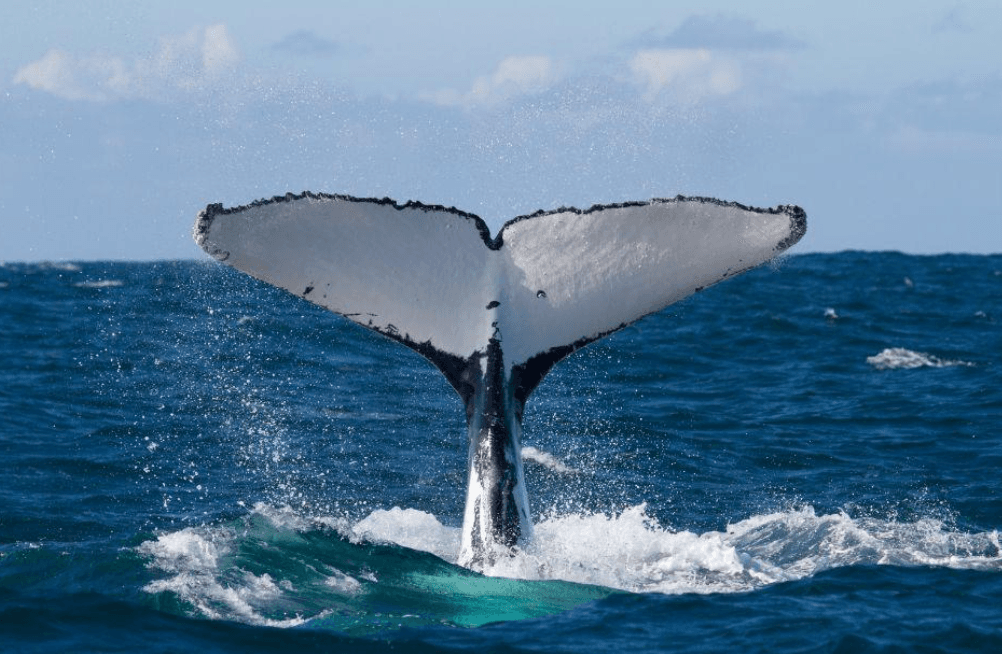
A humpback whale's tail fluke is the broad, horizontal structure at the end of its body. When a whale raises its tail before diving, the underside may become visible, revealing a pattern of light and dark pigmentation.
These markings vary among individuals. Some flukes have extensive white areas, while others appear predominantly dark. The shape of the trailing edge, pigmentation boundaries, and naturally occurring marks can provide additional identifying details.
Researchers consider the combination of these characteristics rather than relying on a single patch of color.
Tail fluke photographs are especially valuable when the underside is visible clearly enough for comparison. However, not every whale raises its fluke during an observation, so researchers often use other identifying features as well.
1. Photographing the Underside of the Tail Fluke
The first step is obtaining a clear photograph of the whale's tail fluke.
Researchers aim to capture the underside as fully as possible, including both sides of the fluke, the central area, and the trailing edge. Good lighting, appropriate focus, and sufficient image resolution help preserve details that might be important for identification.
A photograph taken at an extreme angle may distort the apparent shape of the fluke. Glare, waves, water droplets, or partial obstruction can also make the markings difficult to interpret.
Scientists therefore assess image quality before using a photograph for a confident identification.
2. Examining Natural Pigmentation Patterns
The underside of a humpback whale's fluke often contains contrasting areas of dark and light pigmentation.
Researchers compare the arrangement of these areas between photographs. They may examine the shape of a white patch, the position of a dark region, or the pattern formed along the edges.
The overall arrangement is often more informative than any single marking. Two whales may have similar amounts of white pigmentation but different patterns, allowing researchers to distinguish them when the photographs are sufficiently clear.
Because pigmentation alone can be difficult to interpret in poor-quality images, scientists combine it with other visible features whenever possible.
3. Comparing the Shape of the Fluke
Tail flukes also differ in their overall shape and edge characteristics.
Researchers may examine the width and proportions of the fluke, the shape of its tips, and the contours of the trailing edge. Small differences can help separate individuals whose pigmentation patterns look broadly similar.
However, photographs taken from different angles can make the same fluke appear to have different proportions. Researchers must account for perspective and image quality rather than assuming every apparent difference indicates a different whale.
Reliable identification depends on comparing compatible images and evaluating multiple characteristics together.
4. Looking for Scars and Other Natural Marks
Some humpback whales have visible scars or irregular markings that provide additional identification clues.
These may include healed injuries, unusual marks on the fluke, or distinctive features elsewhere on the body. Such characteristics can help researchers distinguish whales when the tail pattern alone is not conclusive.
Scars and other physical features may change over time, so researchers interpret them carefully. A whale's appearance can also be affected by lighting, water conditions, and the angle of the photograph.
The most useful identification records combine stable-looking features with several independent details.
5. Creating Individual Whale Records
Once researchers have a suitable photograph, they can compare it with existing records in a photo-identification catalogue.
A catalogue may contain photographs, identification codes, observation dates, locations, and notes about the animal's visible characteristics. Researchers can use this information to organize sightings and avoid treating every encounter as a new individual.
When a new photograph matches an existing record with sufficient confidence, the observation may be added to that whale's history.
If the match is uncertain, researchers may retain the photograph as an unidentified or provisional record until stronger evidence becomes available.
6. Using Computer Tools to Compare Photographs
Digital tools can help researchers organize large collections of whale photographs and identify images that may show the same individual.
Image-processing systems may assist with cropping, adjusting image orientation, comparing pigmentation patterns, or ranking possible matches. Some research workflows use automated image-analysis methods to speed up the search process.
These tools are aids rather than guarantees. Poor-quality photographs, unusual viewing angles, and similar markings can lead to incorrect matches.
Researchers should review candidate matches and use established identification criteria before accepting an individual identification.
7. Determining Whether a Whale Returns in Another Season
One of the major benefits of photo-identification is that researchers can compare photographs collected at different times.
Suppose a whale is photographed in Samaná Bay during one breeding season. If a later photograph from another season matches the same individual with sufficient confidence, researchers can document a repeat sighting.
Repeated records can help scientists investigate how often identified whales return to a particular area and how their sightings vary between seasons.
However, the absence of a photograph in a later year does not prove that the whale failed to return. It may have been present without being photographed or identified.
8. Understanding Whale Movements Between Locations
When researchers compare reliable identification records from multiple locations, they may discover that the same whale has been photographed in different areas.
For example, a matching fluke pattern recorded at two separate sites can provide evidence that an individual was observed in both places. If the dates and locations are reliable, the records can contribute to research on broader movement patterns.
Photo-identification does not reveal the whale's exact route between those sightings. Additional tracking information would be needed to reconstruct its path in greater detail.
This distinction helps researchers avoid interpreting two photographs as a complete record of an animal's journey.
9. How Researchers Reduce Identification Errors
Misidentifying an individual can affect estimates of population size, return rates, and movement patterns. Scientists therefore use careful procedures to improve reliability.
These may include:
- Comparing several features rather than one marking.
- Checking the quality and angle of each photograph.
- Reviewing potential matches against existing catalogue images.
- Recording uncertain identifications separately.
- Having additional trained reviewers assess difficult cases.
- Keeping observation dates and locations linked to each record.
When photographs do not provide enough evidence, it is scientifically appropriate to leave an identification unresolved.
A reliable catalogue is more valuable when uncertainty is documented than when every photograph is assigned an individual without sufficient evidence.
10. Why Tail Fluke Identification Matters in Samaná Bay
Samaná Bay is a well-known seasonal destination for humpback whales, making it a meaningful setting for observing these animals during the breeding season.
Individual identification can help researchers organize sightings and investigate patterns of seasonal use. When supported by suitable records, it can contribute to questions about repeat appearances, movement between observation areas, and long-term monitoring.
It is important to distinguish the general usefulness of photo-identification from findings about a specific population. Claims about the number of individually identified whales in Samaná Bay, their return rates, or their routes should be supported by relevant research data.
Can Whale Watchers Help With Photo-Identification?
Visitors sometimes capture photographs of humpback whale flukes during responsible whale-watching trips. Clear, original images may be useful to researchers or conservation organizations if those groups accept contributions from the public.
Before submitting photographs, visitors should follow the organization's instructions and provide accurate dates and locations when known. They should not approach, chase, or delay a whale to obtain a better image.
A photograph should also not be treated as a confirmed scientific identification simply because it resembles an image found online. Matching individuals requires appropriate comparison and review.
Frequently Asked Questions
Can scientists identify every humpback whale by its tail fluke?
No. Some whales do not raise their flukes, and some photographs lack enough detail for reliable identification. Researchers may need additional images or other natural markings.
Do humpback whale tail flukes have unique patterns?
The combination of pigmentation, shape, and other visible characteristics can help distinguish individuals. Researchers evaluate the full pattern rather than assuming one marking is always unique.
Does a whale's tail pattern change over time?
Some physical details, including scars and the appearance of the edges, may change. Pigmentation patterns are often useful for long-term comparison, but researchers still evaluate older and newer photographs carefully.
Can tail fluke photographs prove that a whale migrated between two locations?
Matching photographs can show that the same individual was observed at both locations, provided the identification is reliable. They do not reveal the exact route taken between the observations.
Do scientists use artificial tags to identify every whale in Samaná Bay?
No. Photo-identification uses natural markings and does not require attaching a tag. Other tracking techniques may be used in particular research projects, but they are separate methods.
Can tourists submit whale photographs for research?
Some research programs accept public photographs, but policies differ. Anyone interested should contact the relevant organization and follow its image-submission requirements.
Conclusion
Scientists identify individual humpback whales by comparing the natural pigmentation, shape, and other distinctive features of their tail flukes. Clear photographs allow researchers to build identification catalogues and connect sightings across different dates and locations.
In Samaná Bay, this approach can support research into seasonal whale observations and individual sighting histories. Although photographs cannot reveal every detail of a whale's movements, careful photo-identification provides valuable evidence without requiring direct physical contact with the animal.
The next time a humpback whale raises its tail above the Caribbean Sea, the pattern beneath its flukes may offer more than a memorable sight. It may also provide researchers with clues that help them recognize and study that individual over time.

Local explorer & expert guide in Isla Saona Oficial.