How Do Scientists Determine Whether Humpback Whales Return to Samaná Bay After Leaving?
Humpback whales travel long distances between feeding grounds and breeding regions. Samaná Bay in the Dominican Republic is a well-known location for observing these whales during the North Atlantic breeding season.
But when a whale disappears from view, how can scientists determine whether it returns later And how do they know that a whale observed this year is the same individual recorded during an earlier season?
Researchers investigate these questions using photo-identification, long-term sighting records, and comparisons of individual whale characteristics. These methods can reveal repeated visits and help scientists study how whales use breeding habitats over time.
However, a returning sighting does not necessarily reveal where the whale went while it was absent or prove that it visited the bay continuously between encounters.
This article explains how scientists investigate humpback whale returns and why long-term identification records are important for understanding marine wildlife.
What Does It Mean When a Humpback Whale Returns?
A returning whale is an individual documented in an area on more than one occasion, with an interval during which it was not recorded there.
Researchers may study returns over several different time scales:
- Within a season: An individual is observed, goes undetected for a period, and is subsequently recorded again.
- Between breeding seasons: A whale identified in one year is documented in the same region during a later year.
- Across multiple years: Repeated records show that an individual has used the region in several different seasons.
- Across different locations: Matching identification records indicate that the same whale has been documented in multiple areas.
These patterns provide different types of information. A return within one season does not necessarily demonstrate annual site fidelity, while repeated appearances across multiple years can provide evidence that an individual revisits a breeding region.
Scientists must define what counts as a return before analyzing their records.
1. Photographing Humpback Whale Tail Flukes
One of the most useful methods for recognizing individual humpback whales is photo-identification.
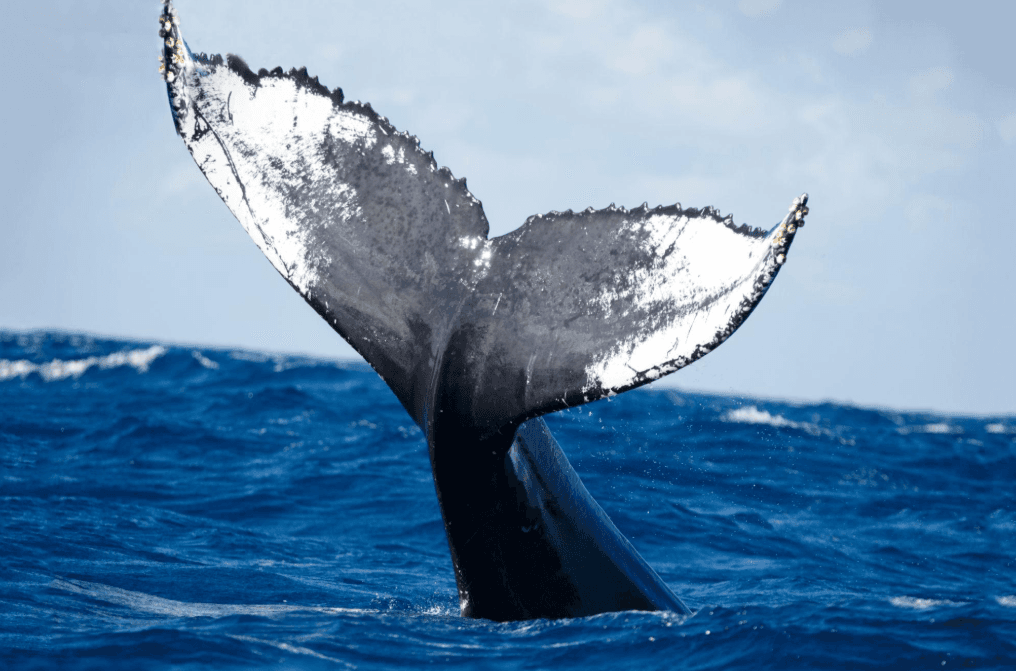
When a whale raises its tail flukes above the water, researchers may photograph the underside. The flukes often display distinctive patterns of pigmentation, scars, and other markings.
Researchers compare these features with photographs already stored in an identification catalog.
A potential match is assessed using several characteristics rather than relying on one small marking alone. Photograph quality, viewing angle, lighting, and the amount of the fluke visible can all affect the reliability of identification.
When the evidence is sufficiently strong, a new sighting can be linked to an existing individual record.
This allows scientists to investigate whether a whale seen in a previous season has returned to Samaná Bay.
2. Maintaining a Long-Term Identification Catalog
Photo-identification becomes especially valuable when records are collected over many years.
Researchers can maintain a catalog containing photographs, identification codes, sighting dates, locations, and relevant observation details.
Each new photograph can be compared with previously documented individuals. Confirmed matches extend the sighting history of a whale, while photographs that cannot be matched confidently may remain unidentified until better evidence becomes available.
A well-maintained catalog helps researchers answer questions such as:
- Which identified whales have been observed in multiple seasons?
- How many years separate recorded encounters?
- Have individual whales been documented in different regions?
- Which individuals have enough observations for meaningful movement analysis?
- How much uncertainty remains in each identification?
The catalog should also record identification confidence. Incorrectly matching two whales could create a false return record, while failing to match the same whale across years could hide a genuine return.
3. Comparing Sightings From Different Years
To investigate whether a whale returns to Samaná Bay, scientists compare records from separate observation periods.
Imagine a hypothetical whale photographed in the bay in 2024 and matched confidently to another photograph from 2026.
This would establish that the same individual was documented in the area during both years.
However, the two records would not show whether the whale visited in 2025, how long it remained during either recorded season, or where it traveled between encounters.
Researchers therefore interpret the records according to what they directly establish.
A confirmed match across years is evidence of repeated use of the region. It is not a complete account of the animal's movements during the intervening period.
4. Distinguishing a Returning Whale From a New Individual
A whale may look similar to another animal without being the same individual. Conversely, photographs of the same whale may look different because of lighting, angle, image quality, or the position of the flukes.
Researchers use systematic comparison procedures to reduce these identification errors.
They may examine:
- The overall pigmentation pattern.
- The distribution of light and dark areas.
- Distinctive scars and markings.
- The shape and visible condition of the flukes.
- The quality and completeness of both photographs.
- Whether other available sighting information supports the proposed match.
When photographs are insufficient, researchers should avoid forcing a match.
A reliable catalog distinguishes confirmed identifications from tentative matches and unresolved photographs. This protects the integrity of long-term research conclusions.
5. Understanding Site Fidelity
In wildlife research, site fidelity refers to the tendency of an animal to return to or repeatedly use a particular area.
If individual humpback whales are documented in Samaná Bay during multiple breeding seasons, researchers can investigate whether those individuals demonstrate site fidelity.
The strength of the evidence depends on the frequency and reliability of the records.
A whale identified in two separate years provides evidence of repeated use. An individual recorded across many years may provide stronger evidence of recurring use, particularly when identification and survey coverage are consistent.
Nevertheless, scientists should not assume that every returning whale uses the same part of the bay or arrives on the same date each year.
Site fidelity also does not necessarily mean exclusive use. A whale may return to Samaná Bay while visiting other regions at different times.
6. Accounting for Whales That Are Not Seen Every Year
One major challenge in return studies is imperfect detection.
A whale may visit a breeding area during a particular season without being photographed. It might remain outside surveyed locations, surface too briefly to be identified, or be missed because weather and sea conditions are unfavorable.
As a result, a missing identification record does not automatically mean that the whale did not return.
Researchers need to distinguish between an animal that was not detected and an animal known to have been absent.
Repeated surveys and information about observation effort can help address this problem. Statistical methods may also estimate detection probabilities when the study design provides sufficient information.
For example, researchers may use appropriate capture-recapture models to investigate the probability that identified whales are detected again, while accounting for the fact that some individuals go unobserved.
The exact model must fit the research question. Not every capture-recapture analysis directly estimates the probability of returning to a particular bay.
7. Investigating Returns to Different Parts of the Region
A whale that disappears from Samaná Bay may still be present elsewhere in the surrounding marine environment.
Researchers can investigate this possibility by comparing identification catalogs and sighting records from different locations.
If the same individual is documented elsewhere during a period when it is absent from the bay, that record provides additional information about its movements.
For example, a whale photographed in one region and later identified in another may help scientists establish a connection between those areas.
However, a lack of sightings elsewhere does not establish that the animal was absent from the wider region. Research coverage may be incomplete, and not every whale encountered can be identified.
Coordinated catalogs and consistent identification standards can make regional comparisons more informative.
8. Using Return Records to Study Movement Patterns
Repeated sightings allow researchers to investigate how individual whales use different places over time.
They can compare the locations where an individual was recorded, the intervals between sightings, and the seasons in which it was documented.
These records may help answer questions about repeated habitat use and connections between different areas.
However, sightings alone cannot reconstruct every movement between encounters.
If a whale is recorded in Samaná Bay in one season and photographed in another location later, the two records establish that the animal was documented in both places. They do not reveal its complete route or every stop it made in between.
Researchers should therefore distinguish confirmed locations from inferred movement pathways.
9. What Can Researchers Learn From Return Patterns?
When sufficient identification records are available, scientists can investigate several aspects of humpback whale ecology.
Repeated habitat use: Researchers can determine whether particular individuals have been documented in the same region during multiple periods.
Variation among individuals: Some whales may have more repeated records than others, although differences in detection must be considered.
Connections between regions: Matching photographs may reveal that identified whales have been observed in separate locations.
Long-term monitoring needs: Return records can identify individuals and periods that deserve further observation.
Conservation planning: Evidence of repeated regional use may help researchers evaluate the importance of an area as part of a whale's broader habitat.
These findings are most useful when researchers clearly describe their data limitations and avoid assuming that every individual follows the same pattern.
10. Why Returning Whales Matter for Conservation
Long-term identification records can contribute to a better understanding of how whales use breeding habitats.
If researchers repeatedly document individual whales in a region, the evidence can help inform assessments of habitat use and support the design of future monitoring programs.
Such information may also be relevant when evaluating potential risks from vessel traffic, coastal development, and other marine activities.
However, return records alone do not establish that a particular area is essential to every whale or that the same animals are present continuously.
Conservation decisions should combine identification records with information about habitat, movement, behavior, and human activities.
Responsible whale watching remains important regardless of whether an individual whale has been recorded previously. Operators should follow applicable regulations and avoid disturbing animals in pursuit of a repeat sighting.
Frequently Asked Questions
How do scientists know whether the same humpback whale returns to Samaná Bay?
Researchers compare photographs of distinctive tail-fluke patterns and other identifying features. A sufficiently reliable match can connect sightings from different dates or years to the same individual.
Does seeing a whale in two different years prove it stayed in the bay between visits?
No. It establishes that the whale was recorded in the region during both observation periods. Its movements during the interval remain uncertain unless additional records provide evidence.
What is site fidelity in humpback whales?
Site fidelity is the tendency of an animal to return to or repeatedly use a particular area. Repeated identification records can help scientists investigate this behavior.
Can researchers determine where a whale went after leaving the bay?
Sometimes. If the whale is identified in another location, that sighting provides evidence of its presence there. However, the full journey may remain unknown.
Why might a returning whale go unidentified?
Photographs may be incomplete, poorly lit, taken from an unfavorable angle, or unavailable. Researchers may also lack a suitable comparison photograph in the existing catalog.
Why are long-term whale identification records important?
They help researchers study individual histories, repeated habitat use, connections between regions, and changes in sightings over time. They can also support marine conservation research.
Conclusion
Scientists determine whether humpback whales return to Samaná Bay by combining photo-identification with long-term sighting records and careful analysis.
A confirmed match across separate visits provides evidence that the same whale has used the area more than once. Yet it does not reveal the animal's entire journey, prove continuous presence, or guarantee that it will return again.
The strongest studies maintain reliable identification catalogs, account for missed detections, and distinguish confirmed observations from uncertain inferences.
By building these records over time, researchers can improve their understanding of humpback whale site fidelity and the role Samaná Bay plays in the lives of individual whales.

Local explorer & expert guide in Isla Saona Oficial.